
With so much choice these days, for soon-to-be-wed couples, things can feel pretty confusing and overwhelming, when it comes to navigating your way through all the ceremony options on offer. So let’s clear up one question that I’m regularly asked . . . what the heck is a humanist wedding?!
First things first. If you don’t already know, then you need to know, what the word ‘humanist’ actually means!
What is a humanist?
A humanist is a non-religious person who believes that this life is the only life of which we can be certain; that the universe is a natural phenomenon with no supernatural power controlling it; and that we can live ethical, happy and fulfilling lives on the basis of reason and humanity.
Humanists trust in science, evidence and reason to make sense of life, and they place human welfare and contentment at the centre of responsible decision making.
Many millions of people share this way of living and of looking at the world, but many have not heard the word ‘humanist’ and don’t realise that it describes what they believe.
Having said all of that, I don’t feel that people should necessarily label themselves as humanist or anything else (unless they particularly want to!) but if they feel, as a result of their beliefs that a humanist ceremony would be fitting and comfortable, they should most certainly have one!
What does a humanist wedding involve?
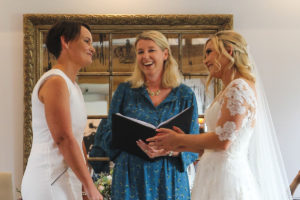
Firstly and most importantly, a humanist wedding is a very personal wedding ceremony, created especially for the couple who are choosing to marry in this particular way. It is not a situation where we are filling in the missing names in a predetermined script (in the way that religious and civil ceremonies require). It is a totally bespoke ceremony, created and delivered as a result of the humanist celebrant meeting and getting to know the couple; taking the time to talk through their ideas, wishes and thoughts for their wedding.
A humanist ceremony has structure and includes key symbolic moments such as couples making vows/promises to each other, a ring exchange (if the couple are having rings) and perhaps other symbolic elements such as readings, poems, music, gestures such as candle lighting or handfasting, etc.
Whilst a humanist wedding is tailored to the couple, it can still have a very traditional feel (if that is what is wanted) but in contrast, it can be very creative, different and alternative – and it can be anything in between!
Humanist weddings are non-religious, but that doesn’t mean there is a total ban on content that has religious references. In several humanist ceremonies I’ve conducted, people have chosen to include hymns or readings that contain words with religious connotations (e.g. angels, heaven, etc). That isn’t necessarily because of a religious belief but rather because those elements have significant meaning to the people whose ceremony it is. For example, a hymn might be included because a couple just like singing it, or because it brings back lovely memories, or they wish to remember a deceased grandparent and perhaps that particular hymn was sung at their grandparents’ wedding.
Whilst a humanist ceremony is non-religious, it will feel inclusive and respectful of the beliefs of all those in attendance.
A religious element that really can’t be included by a humanist celebrant however, is an ‘act of worship’. It would be disrespectful and quite frankly, uncomfortable, for a humanist celebrant to lead a prayer stating,“let us all pray”.
If a brief religious reading or a short prayer is wanted, perhaps for tradition’s sake or to offer a nod to a cultural or religious background, or as a respectful gesture to a member of the family with religious belief, then it may be that it can be accommodated by a member of the family or a close friend leading/reading it.
If a generally religious ceremony is wanted then a priest or an independent celebrant (who has religious beliefs themselves or one who feels comfortable leading prayers, etc) is the better option – and the humanist celebrant will respectfully bow out.
 Can we write our own vows?
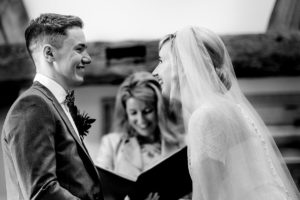
Yes absolutely – and this is really encouraged, as it is such a personal and important moment during the ceremony. Understandably, many couples feel a bit unsure about this part of the wedding and often ask for suggestions from me as a starting point. I am always happy to offer advice, support and guidance with vows whenever needed.
How long does a humanist ceremony last?
Most of the ceremonies I take, last between 30 and 60 minutes, but they can be shorter or longer as required. The beauty of a humanist ceremony is that there really are no rules or restrictions and as a result of them being so personal and meaningful, including various different elements, they are very interesting and engaging events to attend. So even in the case of longer ceremonies, there should be no opportunity for the guests to feel in slightest bit bored! No one should ever be a guest at a wedding ceremony where they are willing it to be over, just so that they can get started on the fizz! I’m pleased to say that I’ve never yet witnessed yawning during one of my ceremonies!
 Is a humanist celebrant officially trained?
Yes definitely. I was trained by and remain accredited by the organisation Humanists UK (formerly the British Humanist Association (BHA) – a long established campaigning charity, with many famous supporters and patrons). I would strongly recommend to any couple seeking to arrange a humanist ceremony, that they choose and appoint a humanist celebrant who has undertaken this excellent, very thorough, lengthy training process. This will ensure they will be working with someone who meets the high standards, code of conduct and expectations of the association; is experienced; who will provide a professional service; and who will offer friendly advice, guidance and support, throughout the whole process.
There are many independent celebrants working in the wedding industry who have had no or very little training, who are not held to account by any organisation, who have no indemnity or public liability insurance – who do not undertake annual continuing professional development and/or refresher training (as I am required to do) and who have no back-up if things go wrong – meaning that you could have no back-up either. Many independent celebrants are less expensive than humanist celebrants – for the reasons cited above – so do beware of cheap imitations!
Having said that, there are many excellent independent celebrants who do an extremely good job (I know many personally, who I would highly recommend) and who do belong to reputable organisations, and who have received training (or have much experience in leading ceremonies). If religious content is wanted, many independent celebrants are very comfortable including prayers, etc in their ceremonies (but some aren’t, so make sure you ask if that is wanted!).
 Where can we get wed?
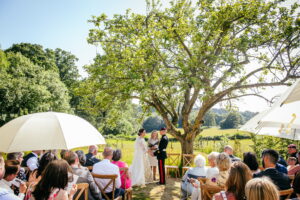
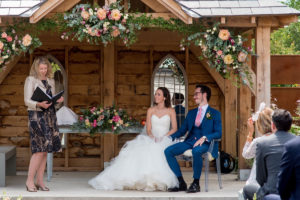
Anywhere – literally anywhere – as long as it is safe (and you have the permission of the landowner)! That is the beauty of a humanist ceremony. You don’t need to have your ceremony in a venue licensed for marriages. I have taken weddings in the back gardens of private homes, in hotels, pubs, on village greens, at designated wedding venues, in village halls, on farms, in barns, in fields, under canvas – you name it, I’ve done it!
Is a humanist wedding ceremony legally recognised?
It is in Scotland, Northern Ireland, Jersey and Guernsey, but not currently in England or Wales.
In order to have your marriage legalised in England and Wales, you simply need to book with a register office, to exchange the contractural words and sign the legal papers. See below and also my FAQs page, for more information on how to organise this.
Humanist weddings have been in the news a lot recently, regarding the possibility of making them legally recognised in England and Wales – do you think this is a good idea and do you think it will happen?
Humanists UK have been campaigning for many years on this issue and continue to work hard, putting pressure on the government to legalise humanist marriages in the same way that they have been for many years in Scotland, Northern Ireland and parts of the Channel Islands. Currently, couples in England and Wales who wish to be legally married but who want to have a humanist wedding, have to arrange to carry out a separate legal registration at a register office.
Most couples tend to do this in advance, often during the week leading up to their humanist ceremony without booking a ceremony room (as unbeknown to many people, you don’t actually have to book a room, unless you will have several guests in attendance). The legal registration can be carried out fairly cheaply, without any fuss at all and a couple can simply book in advance, to go along to the register office with their two witnesses, therefore saving all the special, moving, meaningful moments for their humanist ceremony.
So it would be much simpler for couples if they didn’t have to do this and better all round if humanist weddings were legally recognised. Under the current government it seems that this will not happen anytime soon, but hopefully it will eventually be an option that becomes law and then everyone who wants to marry in this way, will have the legal right to. For the moment though, couples are free to include in their humanist ceremony whatever they want, and hold their ceremony wherever they wish, with no legal restrictions whatsoever – so this is the upside of the absence of legal recognition!
Do I have to be a humanist to have a humanist wedding?
Absolutely not – you don’t have to label yourself a humanist or an atheist, or anything else, to have a humanist ceremony. Plenty of the couples who I have wed or am working with currently, are agnostic (perhaps believing in an afterlife or a supernatural ‘force’ but not following any particular religious faith) and they don’t want religion to feature in their wedding ceremony. As long as a couple don’t expect their humanist celebrant to lead a collective act of worship (e.g. a prayer that everyone is expected to join in with) in their ceremony, a humanist ceremony is absolutely fitting. I am always very clear when speaking to guests at the beginning of any ceremony, that a humanist ceremony should feel inclusive, no matter what the beliefs of those in attendance – all are equally and warmly welcome. We acknowledge and respect all faiths (alongside those who have no faith) and if the couple particularly want there to be a moment of reflection in the proceedings where those who wish to, may pause to pray privately, this can be accommodated.